US Political Polarization and the National Unity Debate
Can America's Political Divide Trigger a National Divorce?

RED VS BLUE DIVIDE
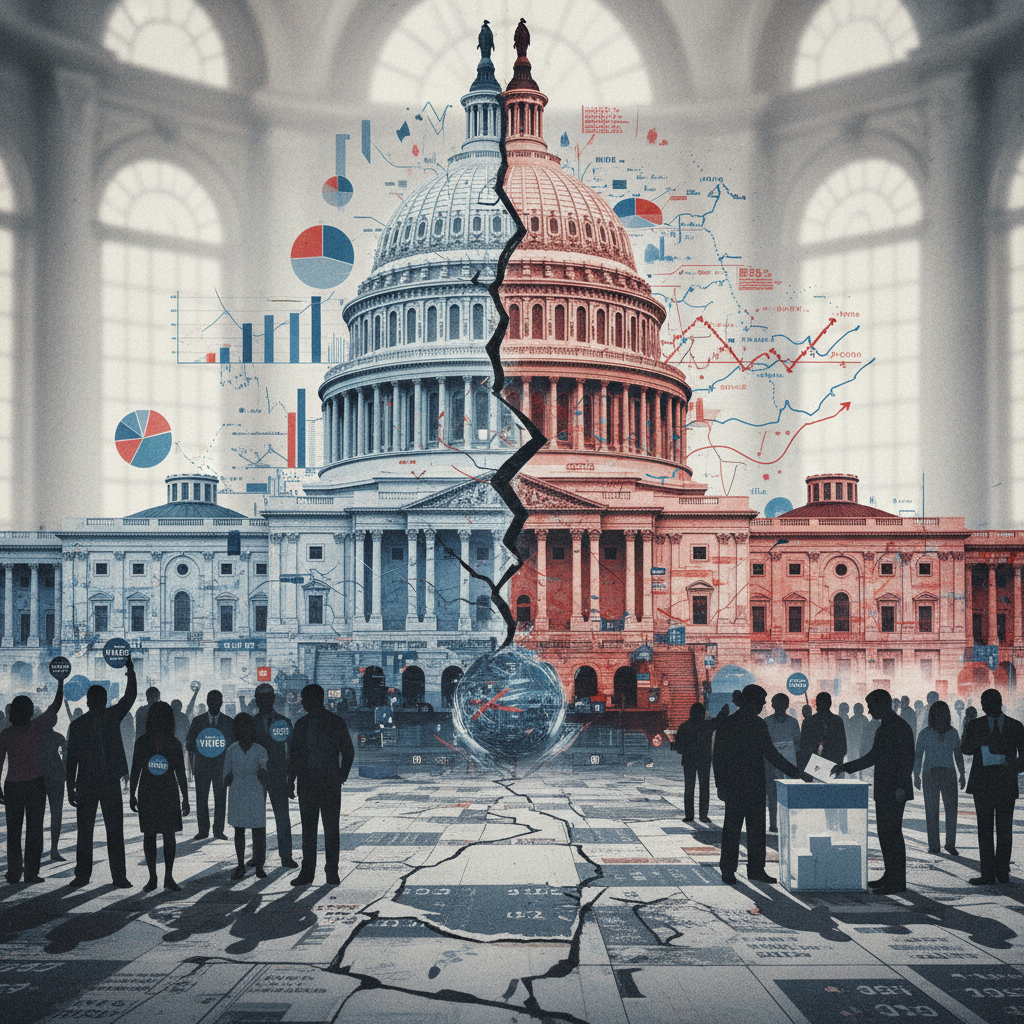
Illustration concept: A detailed editorial illustration showing a stylized, cracked map of the United States lit with blue and red hues, sitting on a wooden desk with newspapers and a globe in the background, professional editorial style.
CSS / PCS revision
Key points, takeaways and exam-style Q&A formatted as a printable one-file study pack.
AI summary
Discussions published by NYT Opinion highlight growing debates over whether intense ideological divides between American states could lead to political fragmentation. The commentary reflects broader public angst regarding democratic stability, foreign aid commitments, and national cohesion in a deeply polarized electorate.
Why this matters
Rising hyper-partisanship in the United States carries direct ramifications for global geopolitical stability and international alliances. For developing democracies and strategic partners, internal friction in Washington threatens predictable diplomatic engagement and defense aid policies. Understanding these domestic fissures provides crucial context for evaluating the future trajectory of Western democratic leadership.
Key takeaways
- Hyper-polarization between progressive and conservative American states challenges traditional federalism and national policy cohesion.
- Ideological divides over governance, energy transition, and foreign aid risk weakening predictable international commitments.
- For Global South countries like Pakistan, American domestic political volatility creates uncertainties in foreign policy, trade, and defense cooperation.
- Preserving institutional resilience and constitutional federalism remains critical to preventing systemic democratic erosion.
Growing ideological friction between conservative and progressive regions in the United States has revived intense debates over national cohesion and the viability of central governance. As highlighted in recent discourse published by NYT Opinion, commentators and citizens are increasingly examining whether profound policy differences between red and blue states pose an existential challenge to the union. This friction extends across foundational areas of governance, from social policy and energy transition to foreign military assistance.
Proponents of greater regional autonomy or political separation contend that irreconcilable cultural and legislative divergences render federal uniformity counterproductive. From this perspective, aggressive federal intervention encroaches upon state sovereignty, creating perpetual political gridlock. Advocates suggest that allowing individual states broader authority to carve out distinct social, environmental, and economic policies could reduce national friction and better reflect local democratic mandates.
Conversely, defenders of national unity argue that fracturing the American republic would destabilize constitutional protections and undermine global democratic security. Opponents of a national divorce emphasize that state boundaries do not neatly divide political opinion, as significant minorities exist within every jurisdiction. Furthermore, maintaining federal integrity is viewed as critical for managing complex national challenges, including climate policy, infrastructure development, and foreign military aid to allies such as Ukraine.
The debate over domestic political cohesion intersects directly with broader public discourse on strategic priorities and civic life. Discussions spanning nuclear energy policy, international assistance commitments, and local social bonds illustrate how domestic stability shapes national strength. When internal consensus breaks down, a nation's ability to maintain a coherent foreign policy and meet global security obligations becomes severely compromised.
For South Asia and developing economies like Pakistan, severe political polarization in Washington creates significant diplomatic and economic uncertainty. Fluctuations in US foreign policy disrupt long-term security partnerships, multilateral climate financing, and international financial institution engagements. A gridlocked or inward-looking American leadership undermines predictable global trade and diplomatic frameworks vital for regional stability.
Ultimately, addressing extreme polarization requires reinforcing constitutional federalism without compromising national solidarity or democratic principles. While federal flexibility allows diverse populations to self-govern effectively, preserving institutional integrity is essential for domestic stability and international credibility. For political analysts and students of international relations, tracking these internal democratic pressures provides essential insight into the future of Western geopolitical leadership.
Frequently asked questions
- What is driving the concept of a political divorce in the US?
- Deepening ideological polarization between conservative and progressive states on governance, social policy, and federal authority has prompted debates on whether central national unity remains viable.
- How does US domestic polarization affect global geopolitical stability?
- Internal political paralysis in Washington often leads to volatile foreign policy shifts, inconsistent foreign aid delivery, and reduced predictability in international alliances.
- Why is this debate relevant to developing nations and Pakistan?
- US policy consistency directly influences global trade, multilateral financial institutions, regional security balances, and diplomatic engagements critical to developing nations.
Source & transparency
- By:
- The Reviser Desk
- Source:
- NYT Opinion
- Original publication:
- Aug 14, 2026, 5:01 PM
- The Reviser publication:
- Aug 14, 2026, 5:01 PM
- Updated:
- Aug 14, 2026, 5:32 PM
This report was independently written by The Reviser editorial desk from verified source material. It is not original on-the-ground reporting by The Reviser.
Related stories

HEALTH CARE POLICY DEBATE
US Health Care Debate: Examining Republican Policy Proposals
AI summaryAccording to NYT Opinion, Republican lawmakers are enacting policies that reduce healthcare affordability for American consumers. The debate highlights the ongoing ideological tension between market-driven fiscal conservatism and state-supported public welfare systems.
DEMOCRATIC MIDTERM STRATEGY EXAMINED
US Midterm Prospects: Democratic Divisions and Polling Realities
AI summaryRecent political commentary from NYT Opinion highlights rising internal divisions within the Democratic Party ahead of the US midterm elections. The analysis points to polling inaccuracies and competing ideological strategies as key factors shaping party prospects.

POPULISM AND SATIRE IN POLITICS
Nigel Farage, Populism, and Satire in British Politics
AI summarySatirical visual commentary by illustrator Martin Rowson in Guardian Opinion highlights the evolving role of populist rhetoric in British electoral politics, specifically regarding Nigel Farage's campaign in Clacton. The commentary reflects broader systemic debates on democratic accountability, media narrative framing, and the global resurgence of right-wing populism.

TRUTH AND ACCOUNTABILITY
Political Accountability vs Reconciliation in Governance
AI summaryA recent commentary in NYT Opinion examines how attempts to rewrite history after political violence undermine genuine reconciliation. The analysis emphasizes that political stability requires rigorous legal accountability rather than political expediency.