Nigel Farage Clacton Win Sparks Financial Scrutiny Debate
Clacton Victory Fails to Shield Nigel Farage from Financial Oversight

FARAGE CLACTON VOTE SCRUTINY
Illustration concept: A high-contrast editorial vector illustration featuring political campaign podiums alongside magnifying glasses over financial documents, clean modern aesthetic.
CSS / PCS revision
Key points, takeaways and exam-style Q&A formatted as a printable one-file study pack.
AI summary
According to Guardian Opinion, Reform UK leader Nigel Farage secured a victory in a Clacton byelection that was boycotted by major political parties. Despite the win, Farage continues to face regulatory scrutiny regarding an unreported £5 million gift from an overseas cryptocurrency billionaire.
Why this matters
This development highlights the ongoing tension between populist political movements and regulatory watchdogs overseeing electoral finance. The outcome underscores that electoral wins do not exempt political figures from statutory financial disclosures and media scrutiny. Understanding these dynamics offers broader insights into campaign transparency and institutional accountability across modern democracies.
Key takeaways
- Electoral victories do not absolve political figures from statutory campaign finance regulations and mandatory financial disclosures.
- Framing regulatory oversight as an establishment conflict threatens to undermine democratic watchdogs and public accountability.
- The presence of significant foreign capital, such as crypto-backed gifts, emphasizes the global need for strict electoral funding checks.
- Institutional governance and independent journalism serve as vital balance mechanisms against populist political defiance.
Reform UK leader Nigel Farage secured a byelection victory in Clacton, a contest he initiated that was subsequently boycotted by major political parties as a stunt. Rather than attending the official vote count, Farage celebrated with supporters at a broadcasted event termed "Farage Fest," covered by a friendly television network. The unusual nature of the race was further highlighted by comedian Count Binface, wearing a jumpsuit and a bin on his head, who nevertheless captured 27 percent of the vote.
According to an analysis by Guardian Opinion, the byelection outcome does not clear Farage from ongoing regulatory and media investigations into his financial affairs. Central to the scrutiny is an inquiry into whether the Reform UK leader failed to declare a £5 million gift originating from an overseas cryptocurrency billionaire. While Farage has attempted to frame these probes as an establishment-driven confrontation, commentators argue that electoral results cannot replace statutory financial compliance.
The commentary notes a broader pattern in which Reform UK has increasingly attacked regulatory watchdogs and journalists posing challenging questions. By depicting oversight mechanisms as part of a hostile establishment, populist political entities attempt to deflect from standard democratic scrutiny. However, public regulatory institutions remain essential to ensuring political campaigns operate within established legal limits.
From a governance perspective relevant to competitive examination candidates analyzing political institutions, the controversy highlights the critical relationship between democratic mandates and institutional checks and balances. For developing democracies, including Pakistan and regional state systems, the case reinforces the necessity of empowered election authorities, robust campaign finance frameworks, and independent journalism to prevent unchecked foreign capital from influencing political processes.
In conclusion, Guardian Opinion stresses that a localized election victory cannot acquit political figures of mandatory financial obligations. Sustaining democratic integrity requires all political actors, regardless of public popularity or anti-establishment rhetoric, to remain fully accountable to regulatory standards and transparent funding practices.
Frequently asked questions
- What occurred during the Clacton byelection?
- Nigel Farage and Reform UK won the Clacton byelection, while comedian Count Binface secured 27 percent of the vote in a contest major political parties boycotted.
- Why is Nigel Farage facing financial investigation?
- Farage is under scrutiny regarding whether he failed to report a £5 million gift from an overseas cryptocurrency billionaire.
- What concern does Guardian Opinion express regarding Reform UK?
- Guardian Opinion highlights concern over Reform UK's growing attacks against watchdogs and investigative journalists asking questions about political finances.
Source & transparency
- By:
- The Reviser Desk
- Source:
- Guardian Opinion
- Original publication:
- Aug 14, 2026, 5:06 PM
- The Reviser publication:
- Aug 14, 2026, 5:06 PM
- Updated:
- Aug 14, 2026, 5:32 PM
This report was independently written by The Reviser editorial desk from verified source material. It is not original on-the-ground reporting by The Reviser.
Related stories
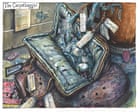
POPULISM AND SATIRE IN POLITICS
Nigel Farage, Populism, and Satire in British Politics
AI summarySatirical visual commentary by illustrator Martin Rowson in Guardian Opinion highlights the evolving role of populist rhetoric in British electoral politics, specifically regarding Nigel Farage's campaign in Clacton. The commentary reflects broader systemic debates on democratic accountability, media narrative framing, and the global resurgence of right-wing populism.

RED VS BLUE DIVIDE
US Political Polarization and the National Unity Debate
AI summaryDiscussions published by NYT Opinion highlight growing debates over whether intense ideological divides between American states could lead to political fragmentation. The commentary reflects broader public angst regarding democratic stability, foreign aid commitments, and national cohesion in a deeply polarized electorate.

VIETNAM PARALLELS IN IRAN STRATEGY
Comparing US Iran Strategy to the Vietnam Conflict Framework
AI summaryAn analysis featured in Foreign Policy suggests that contemporary American strategy toward Iran echoes the structural miscalculations of the Vietnam War. Examining strategic ambiguity, executive decision-making, and regional instability, this piece explores the implications of US Middle East interventions for regional stability and Pakistani diplomacy.

HEALTH CARE POLICY DEBATE
US Health Care Debate: Examining Republican Policy Proposals
AI summaryAccording to NYT Opinion, Republican lawmakers are enacting policies that reduce healthcare affordability for American consumers. The debate highlights the ongoing ideological tension between market-driven fiscal conservatism and state-supported public welfare systems.