China CPC Governance Model and Pakistan Bilateral Ties
Examining China's Governing Framework and Its Regional Impact
CHINA PAKISTAN GOVERNANCE ANALYSIS
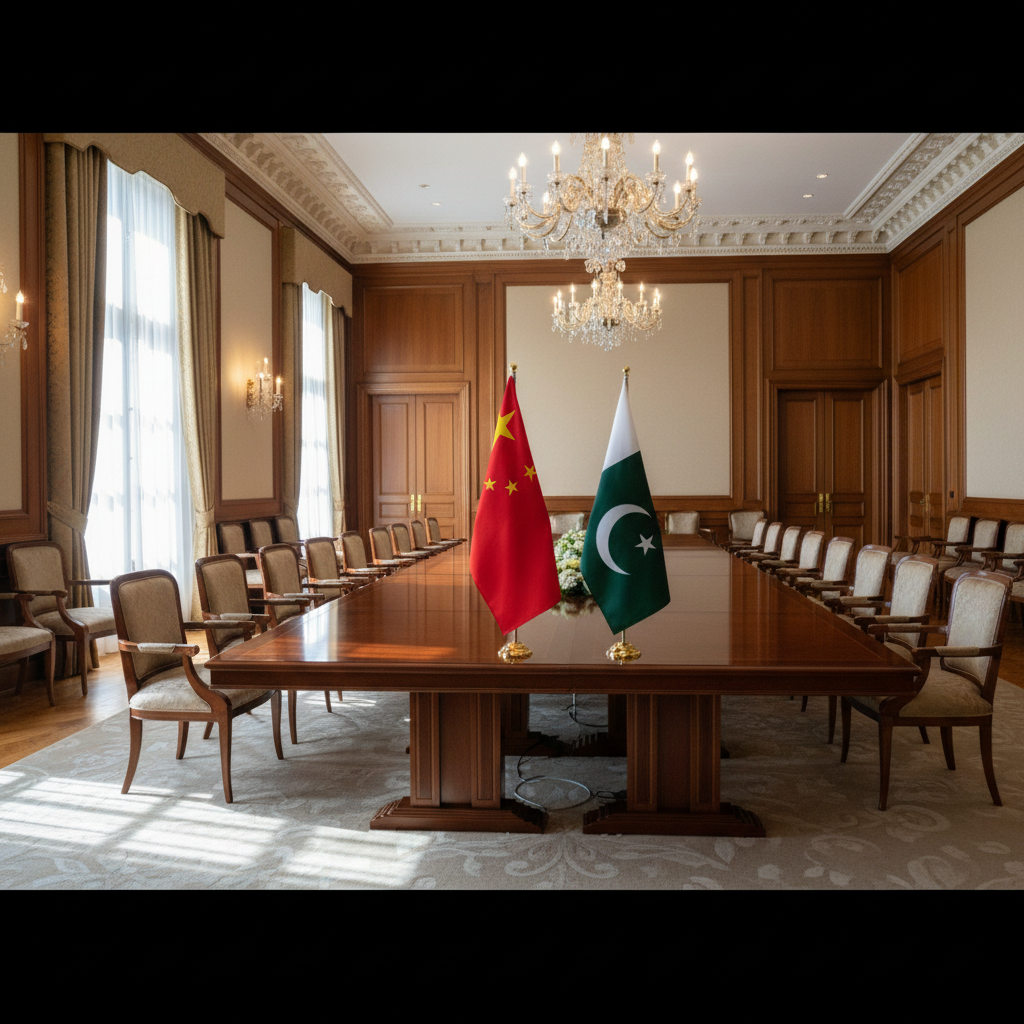
Illustration concept: A formal diplomatic meeting room with Chinese and Pakistani flags displayed side by side.
CSS / PCS revision
Key points, takeaways and exam-style Q&A formatted as a printable one-file study pack.
AI summary
Since the 18th CPC National Congress, China's leadership under Xi Jinping has focused on institutional party governance and long-term political strategy. These internal Marxist party-building doctrines shape Beijing's foreign policy framework, directly influencing bilateral exchanges with Pakistan.
Why this matters
Understanding the ideological and structural mechanisms of the CPC provides critical insights for South Asian policymakers navigating strategic partnerships. For Pakistan, aligning governance frameworks with long-term bilateral initiatives requires evaluating both economic opportunities and institutional capacities.
Key takeaways
- Internal CPC governance strategies under Xi Jinping directly shape China's long-term foreign policy and regional outreach.
- Centralized Chinese decision-making provides sustained policy continuity for major initiatives like the China-Pakistan Economic Corridor.
- Structural differences between China's party-state and Pakistan's democracy present administrative challenges for strategic execution.
- Effective bilateral engagement requires Pakistan to enhance domestic governance capacity and institutional policy oversight.
Following the 18th National Congress of the Communist Party of China (CPC), the central committee led by General Secretary Xi Jinping formulated updated concepts regarding long-term Marxist party administration. According to commentary published by The Nation Columns, these core strategies aimed to modernize governance mechanisms while reinforcing internal party discipline to effectively manage ongoing national and international development challenges.
From a broader geopolitical perspective, China's internal organizational consolidation directly shapes its external statecraft, particularly within South Asia. The institutional continuity generated by a centralized governance framework enables Beijing to initiate, fund, and maintain long-term international commitments, most notably demonstrated through multi-billion-dollar investments like the China-Pakistan Economic Corridor and related diplomatic exchanges.
However, international observers and policy analysts emphasize the inherent structural differences between China's party-state architecture and Pakistan's decentralized parliamentary democratic system. While Beijing offers strategic stability and steady capital deployment, partner nations frequently encounter administrative delays, internal political transitions, and local governance frictions that can complicate long-term project execution and bilateral alignment.
For Pakistani policymakers and civil service aspirants studying regional relations, navigating this relationship requires building stronger domestic administrative capacity and cohesive long-term planning. Effective bilateral cooperation demands high-level technical synchronization alongside rigorous constitutional oversight, ensuring that strategic partnerships yield sustainable socioeconomic progress without compromising local institutional autonomy.
Ultimately, the ongoing progression of China-Pakistan exchanges demonstrates how internal party doctrine drives external strategic behavior. Maintaining a balanced, mutually beneficial partnership requires continuous evaluation of both nations' administrative mechanics, policy timelines, and strategic objectives.
Frequently asked questions
- How do CPC governance reforms affect foreign policy?
- Internal CPC reforms ensure centralized policy continuity, allowing China to maintain long-term diplomatic, economic, and strategic commitments across regional partnerships like Pakistan.
- What is the key challenge in Pakistan-China institutional cooperation?
- The primary challenge involves aligning Pakistan's decentralized parliamentary democratic processes with China's centralized, long-term party-state planning framework.
Source & transparency
- By:
- The Reviser Desk
- Source:
- The Nation Columns | Dawn Opinion
- Original publication:
- Aug 14, 2026, 8:13 PM
- The Reviser publication:
- Aug 14, 2026, 8:13 PM
- Updated:
- Aug 15, 2026, 7:03 AM
This report was independently written by The Reviser editorial desk from verified source material. It is not original on-the-ground reporting by The Reviser.
Related stories

PAKISTAN DEFENCE AND ECONOMIC PACTS
Pakistan Geopolitics: Makkah Agreement vs CPEC Analysis
AI summaryPakistan marked its 79th Independence Day with visible public enthusiasm surrounding the trilateral Makkah Joint Defence Agreement with Saudi Arabia and Türkiye. Dawn Opinion compares this strategic geopolitical pact to the economic expectations previously attached to the China-Pakistan Economic Corridor over a decade ago.

PAKISTANI HOSTAGES SOMALI PIRACY
Somali Pirate Hijacking Exposes Pakistan Maritime Policy Flaws
AI summaryEleven Pakistani seafarers remain captive after Somali pirates hijacked their oil tanker over three months ago, prompting urgent appeals for government intervention. The incident highlights diplomatic hurdles and systemic gaps in maritime labor protections for Pakistani crew members.

FORENSIC SYSTEM FLAWS EXPOSED
Karachi Autopsy Flaws Highlight Forensic System Crises
AI summaryKarachi Police Surgeon Dr Summaiya Tariq highlighted 14 major procedural deficiencies in the initial autopsy of a 25-year-old man found dead in Gulistan-i-Jauhar. Her public intervention and subsequent social media reflections underscore the deep structural and institutional pressures facing forensic medical examiners in Pakistan.

EUROPE RIVERS DYING CLIMATE RISK
Climate Change Threats to European Rivers Reshape Global Trade
AI summaryAn analysis published by NYT Opinion indicates that climate change is severely impacting Europe's major river systems and altering traditional distributions of wealth and power. This environmental shift exposes vulnerability in advanced economies, offering crucial policy lessons for developing nations like Pakistan.