Role of Dissent in Democracy and Governance Principles
Why Dissent Remains the Core Engine of Democratic Resilience
DISSENT AND DEMOCRACY
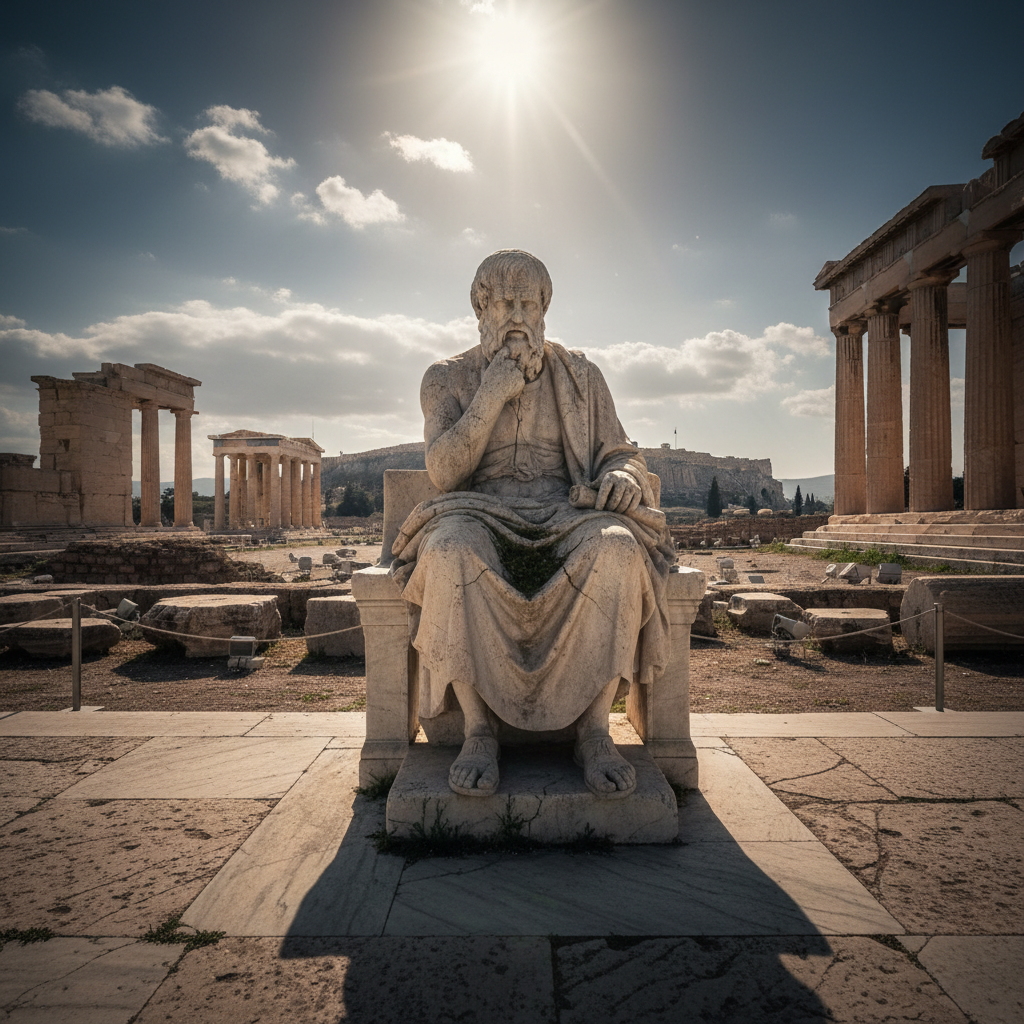
Illustration concept: A classical stone statue of Socrates sitting thoughtfully in an ancient Athenian forum, dramatic overhead sunlight, cinematic detailed photography style.
CSS / PCS revision
Key points, takeaways and exam-style Q&A formatted as a printable one-file study pack.
AI summary
According to a commentary published by Express Tribune Opinion, the trial of Socrates in ancient Athens underscores how suppressing dissenting voices weakens the foundational spirit of democratic governance. The analysis argues that modern constitutional democracies, including Pakistan, must embrace constructive criticism as a vital tool for institutional health and national stability.
Why this matters
For civil servants and policy analysts, understanding the balance between state authority and civil liberties is crucial for constitutional governance. In Pakistan, where political polarization frequently challenges institutional norms, safeguarding peaceful dissent is essential for long-term political consolidation and socio-economic progress.
Key takeaways
- Dissent serves as a vital self-correcting dynamic in democratic systems, preventing policy stagnation and institutional decay.
- The trial of Socrates highlights the historical risk of state mechanisms being deployed to silence intellectual and political critique.
- Conflating legitimate public criticism with state subversion erodes public trust and worsens political polarization in developing democracies.
- Constitutional resilience in Pakistan relies on balancing national security imperatives with the protection of civil liberties and freedom of speech.
The trial of Socrates by an Athenian jury on charges of impiety and corrupting the youth remains one of history's defining moments regarding state authority and freedom of thought. According to Express Tribune Opinion, this historical inflection point demonstrates that suppressing critical inquiry undermines the fundamental essence of democratic governance. When political systems attempt to silence intellectual dissent, they inadvertently erode the very self-correcting mechanisms required for institutional longevity.
From a governance perspective, dissenting voices serve as a crucial pressure valve within a constitutional democracy. Critique exposes institutional blind spots, deters executive overreach, and encourages policy innovation by challenging prevailing orthodoxy. Proponents of robust free expression emphasize that dynamic societies thrive when public debates accommodate conflicting ideological perspectives, allowing states to evolve without resorting to authoritarian coercion.
Conversely, state authorities often view radical or unbridled dissent with caution, arguing that unchecked agitation can compromise public order and national security. In fragile democracies or state structures facing asymmetric security threats, governments frequently prioritize stability and social cohesion over unrestricted discourse. However, political analysts caution that conflating legitimate policy critique with state subversion creates a crisis of institutional legitimacy.
For Pakistan, the struggle to balance executive authority with constitutional freedoms carries profound regional and domestic implications. Historical precedents show that stifling democratic dissent deepens societal polarization and destabilizes governance frameworks. Enhancing institutional trust requires state organs to respect fundamental rights while upholding the rule of law through transparent, non-partisan mechanisms.
Ultimately, dissent should not be viewed as an existential threat to governance, but as an indispensable component of state resilience. Democratic systems achieve lasting stability not by enforcing ideological uniformity, but by building robust frameworks capable of absorbing and institutionalizing public critique.
Frequently asked questions
- Why is the trial of Socrates significant in political science?
- The trial of Socrates serves as a foundational historical precedent illustrating how ancient Athenian democracy suppressed critical thought, highlighting the ongoing tension between state authority and intellectual freedom.
- How does dissent contribute to democratic stability?
- Dissent acts as a feedback loop that identifies governance failures, holds state institutions accountable, and prevents authoritarian consolidation.
- What are the implications of suppressing dissent in Pakistan?
- Restricting peaceful criticism deepens political polarization, weakens public trust in state institutions, and hinders constructive policy reform.
Source & transparency
- By:
- The Reviser Desk
- Source:
- Express Tribune Opinion
- Original publication:
- Aug 13, 2026, 2:51 PM
- The Reviser publication:
- Aug 13, 2026, 2:51 PM
- Updated:
- Aug 14, 2026, 4:04 PM
This report was independently written by The Reviser editorial desk from verified source material. It is not original on-the-ground reporting by The Reviser.
Related stories

ACADEMIA IN CRISIS
Why Higher Education Faces an Institutional Trust Crisis
AI summaryA growing critique from former insiders highlights how Western universities' social justice rhetoric often contrasts with internal labor precarity and symbolic diversity efforts. This divergence between administrative messaging and operational realities offers crucial insights for higher education governance globally, including in Pakistan.

RED VS BLUE DIVIDE
US Political Polarization and the National Unity Debate
AI summaryDiscussions published by NYT Opinion highlight growing debates over whether intense ideological divides between American states could lead to political fragmentation. The commentary reflects broader public angst regarding democratic stability, foreign aid commitments, and national cohesion in a deeply polarized electorate.

URBAN HEAT CRISIS LESSONS
Phoenix Heat Crisis Shows Escalating Risk for Urban Governance
AI summaryCommentary published by NYT Opinion highlights how rising temperatures in Phoenix are pushing firefighters and emergency personnel into continuous life-saving operations. The crisis underscores the growing demand for comprehensive heat management strategies in vulnerable urban centers globally.
MERIT VS AFFIRMATIVE ACTION
Racial Preferences in US Admissions and Meritocracy Debate
AI summaryRecent commentary from WSJ Opinion highlights concerns that race-conscious preferences persist in elite institutions like Duke Law despite landmark legal prohibitions. The debate highlights broader structural questions regarding meritocracy, diversity policy, and affirmative action frameworks globally.