Why Higher Education Faces an Institutional Trust Crisis
Rhetoric Versus Reality: The Deepening Crisis of Faith in Higher Education
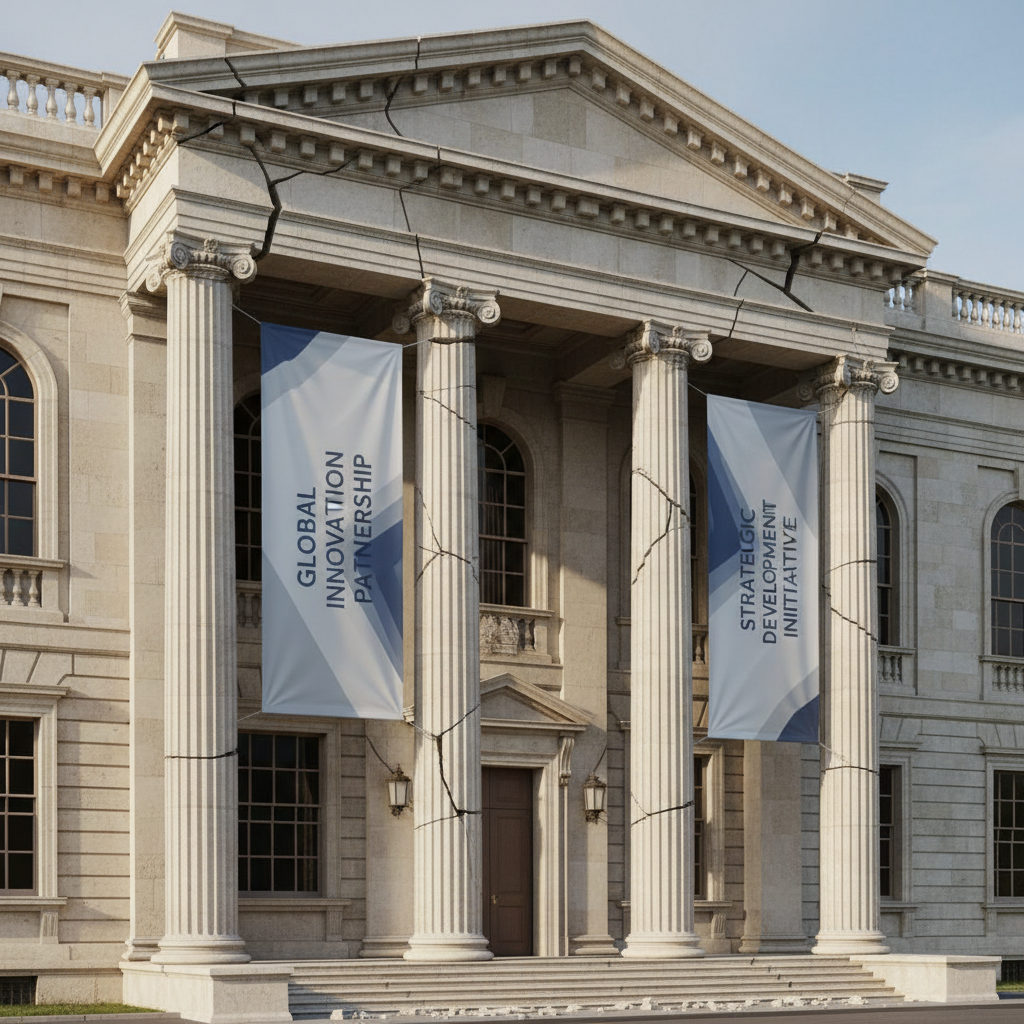
ACADEMIA IN CRISIS
Illustration concept: An abstract conceptual image showing a grand classic university building made of stone, with visible fracture lines running through its pillars, reflecting internal tension between modern corporate administrative banners and traditional academic architecture.
CSS / PCS revision
Key points, takeaways and exam-style Q&A formatted as a printable one-file study pack.
AI summary
A growing critique from former insiders highlights how Western universities' social justice rhetoric often contrasts with internal labor precarity and symbolic diversity efforts. This divergence between administrative messaging and operational realities offers crucial insights for higher education governance globally, including in Pakistan.
Why this matters
The erosion of trust in higher education institutions reflects broader systemic issues in university governance, faculty welfare, and intellectual diversity. For developing nations like Pakistan, understanding these institutional flaws is essential to designing sustainable educational reforms that prioritize academic freedom and labor security over performative metrics.
Key takeaways
- Divergence between university administrative rhetoric and internal labor practices erodes institutional credibility.
- Symbolic diversity frameworks often obscure deeper class inequities and the systemic exploitation of adjunct faculty.
- Developing nations importing Western higher education models must guard against administrative performativity and bureaucratic expansion.
- Sustainable educational reform requires protecting tenure, safeguarding academic freedom, and ensuring labor equity.
A growing wave of disenchantment is emerging from within the halls of Western academia, where former scholars and faculty members are increasingly questioning the structural integrity of higher education. As highlighted in a Washington Post Opinions discussion featuring Megan McArdle and former Bates College professor Tyler Austin Harper, the tension between universities' progressive public rhetoric and their internal operational practices has exposed deep institutional fractures. Central to this critique is the observation that modern tertiary institutions frequently substitute performative commitments to diversity for meaningful structural reform.
At the core of the debate is the distinction between symbolic inclusion and economic equity. Critics point out that institutional frameworks for diversity, equity, and inclusion often devolve into tokenism, failing to address the fundamental class divisions that define university admissions and hiring. While elite universities champion social justice branding, their economic business models increasingly depend on the exploitation of underpaid adjunct faculty and the steady erosion of tenured positions, creating an unstable labor hierarchy beneath a veneer of progressive virtue.
Conversely, defenders of contemporary academic diversity efforts argue that formal equity initiatives remain essential mechanisms for addressing historical exclusion. From this perspective, administrative policies designed to promote representation provide vital institutional accountability in historically homogenous spaces. Proponents maintain that despite implementation flaws, these frameworks foster necessary cultural changes within academic environments that would otherwise reproduce entrenched social privileges.
For developing countries such as Pakistan, this Western academic crisis carries significant policy implications. The Pakistani higher education sector, overseen by the Higher Education Commission (HEC), faces structural distress marked by severe budget cuts, precarious employment for young researchers, and widespread administrative top-heaviness. When Pakistani institutions blindly adopt Western administrative frameworks or prioritize vanity metrics over faculty welfare and rigorous inquiry, they risk importing systemic defects without building genuine research capacity.
Furthermore, the issue of ideological conformity and performative governance resonates directly with the governance challenges in South Asian universities. In Pakistan, hyper-politicization and administrative heavy-handedness frequently stifle independent scholarship and critical inquiry. When universities prioritize ideological alignment or bureaucratic compliance over intellectual freedom and economic security for educators, the ultimate casualty is the quality of national human capital and research output.
Ultimately, restoring public faith in higher education requires aligning institutional practice with foundational academic values. For both Western systems and global South institutions, sustainable reform demands moving beyond surface-level rhetoric to fix basic structural imbalances: protecting academic tenure, ensuring fair labor standards for teaching staff, and preserving pluralistic intellectual environments.
Frequently asked questions
- What is driving the loss of faith in higher education among faculty?
- Faculty disaffection is primarily driven by the gap between universities' progressive social justice rhetoric and their internal practices, including the decline of tenure, reliance on underpaid adjuncts, ideological conformity, and tokenistic diversity policies.
- How does tokenism affect academic diversity efforts?
- Critics argue that tokenism reduces complex socioeconomic and racial inequalities to superficial representation, allowing institutions to project a progressive image while ignoring deep-seated economic barriers and structural labor inequities.
- What lessons does the crisis in Western academia offer for Pakistan?
- Pakistani policy makers must focus on core educational fundamentals—such as research funding, faculty job security, and intellectual pluralism—rather than uncritically copying Western administrative models that emphasize ranking metrics over pedagogical substance.
Source & transparency
- By:
- The Reviser Desk
- Source:
- Washington Post Opinions
- Original publication:
- Aug 14, 2026, 10:00 AM
- The Reviser publication:
- Aug 14, 2026, 10:00 AM
- Updated:
- Aug 14, 2026, 10:17 AM
This report was independently written by The Reviser editorial desk from verified source material. It is not original on-the-ground reporting by The Reviser.
Related stories

UNFINISHED INDEPENDENCE
Pakistan Governance Reforms and the Legacy of 1947
AI summaryDecades after achieving statehood in 1947, Pakistan continues to grapple with institutional structures and bureaucratic mindsets inherited from colonial rule. True sovereign independence requires transitioning from an administrative model designed for imperial control to a governance framework focused on citizen empowerment.
FINES VS TRAFFIC FLOW
How Revenue Quotas Distort Traffic Governance in Lahore
AI summaryAn analysis published by Dawn Opinion highlights how traffic wardens in Lahore prioritize issuing fines over regulating chaotic intersections, driven by state-imposed quota incentives. This reliance on revenue generation over public safety signals a systemic failure in urban governance that degrades traffic discipline across major Pakistani cities.

CRISIS OF POLITICAL GATEKEEPING EXPLAINE
Political Gatekeeping and Party Power: Lessons from US Politics
AI summaryA commentary from NYT Opinion suggests that the American political right risks committing strategic errors similar to its opponents by failing to enforce internal party gatekeeping. This dynamic highlights broader political risks where unchecked populism and organizational laxity undermine long-term governance stability.

AFGHAN POLICY AT CROSSROADS
Western Sanctions on Afghanistan Demand Policy Shift
AI summaryAn analytical column in NYT Opinion highlights that restrictive Western policies and sanctions on post-2021 Afghanistan continue to inflict economic hardship on a new generation of Afghans eager to rebuild their society. While Western powers justify isolation through human rights concerns, critics argue that economic paralysis undermines long-term stability across South and Central Asia.