Japan Tax Cut: BOJ ETF Sales Proposed as Funding Source
LDP Lawmaker Suggests Tapping Bank of Japan ETF Holdings for Tax Cut Relief
BOJ ETFS FOR TAX CUT
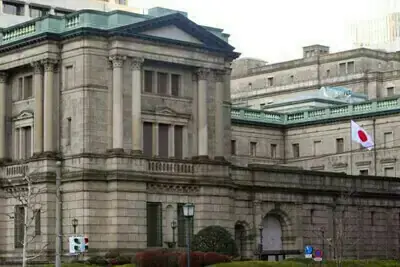
Illustration concept: A modern cityscape of Tokyo with the Bank of Japan building in the foreground, overlayed with abstract financial stock chart curves and Japanese yen symbols.
AI summary
A senior Liberal Democratic Party official suggested utilizing proceeds from the Bank of Japan's ETF holdings to offset revenue losses from a proposed sales tax reduction. Prime Minister Sanae Takaichi aims to lower food sales taxes to 1% without floating new government bonds.
Key takeaways
- LDP lawmaker Daishiro Yamagiwa proposed selling BOJ's 37-trillion-yen ETF portfolio faster to fund a food sales tax cut.
- PM Sanae Takaichi's initiative lowers food sales tax from 8% to 1% for two years.
- The tax reduction leaves an annual revenue shortfall of approximately 5 trillion yen ($31.71 billion).
- Takaichi has ruled out issuing new government debt, focusing instead on non-tax revenue options.
- Under current central bank guidelines, offloading the BOJ's entire ETF holdings would take roughly 100 years.
Japan could turn to the central bank's massive equity portfolio to finance a temporary relief plan for consumers, according to a prominent ruling party lawmaker. Speaking during a recent online broadcast, Daishiro Yamagiwa of the Liberal Democratic Party’s tax panel suggested that selling off portions of the Bank of Japan’s exchange-traded fund reserves could offset government revenue losses.
The proposal comes as Prime Minister Sanae Takaichi advances a major fiscal package designed to ease living costs. The government approved a measure to reduce the sales tax levied on grocery items from 8 percent to 1 percent over a two-year period. However, the policy leaves an estimated funding deficit of roughly 5 trillion yen ($31.71 billion) each year.
Rather than taking on additional sovereign obligations, Takaichi has insisted that the fiscal gap be bridged through non-tax revenues. This self-imposed constraint against issuing fresh government bonds has forced policy architects to seek unconventional funding mechanisms amid growing scrutiny over Japan’s public balance sheet.
To plug the hole, Yamagiwa pointed to the Bank of Japan’s 37-trillion-yen holdings in exchange-traded funds. He noted that elevated stock valuations provide a favorable backdrop for accelerating divestment, arguing that the central bank's existing timetable—which spans nearly a century—could be significantly compressed without unsettling equity markets.
According to Business Recorder, bringing the central bank's balance sheet into the political discourse underscores the mounting financial friction within the administration's economic policy agenda.
Frequently asked questions
- What is Prime Minister Takaichi's tax cut plan?
- The plan reduces Japan's sales tax on food products from 8% to 1% for a period of two years.
- How large is the revenue shortfall expected from the tax cut?
- The tax reduction is projected to create an annual revenue shortfall of around 5 trillion yen (approximately $31.71 billion).
- Why are BOJ ETF holdings being considered as a source of funds?
- Because PM Takaichi pledged not to issue new bonds, lawmakers like Daishiro Yamagiwa view the central bank's 37-trillion-yen ETF portfolio as a viable source of non-tax revenue during strong market conditions.
Source & transparency
- By:
- The Reviser Desk
- Source:
- Business Recorder
- Original publication:
- Aug 8, 2026, 9:24 PM
- The Reviser publication:
- Aug 8, 2026, 9:24 PM
- Updated:
- Aug 8, 2026, 9:31 PM
This report was independently written by The Reviser editorial desk from verified source material. It is not original on-the-ground reporting by The Reviser.
Related stories

400K TRUCKS GROUNDED STRIKE
Freight Strike Halts 400,000 Trucks in Pakistan
AI summaryOver 400,000 goods-carrying vehicles have suspended operations across Pakistan, triggering serious disruption to industrial supply chains and international exports. According to reports from Dawn Business, business community leaders are urging immediate official intervention to resolve transport grievances and prevent further trade losses.

CHINA INFLATION COOLS IN JULY
China July Inflation Slows as Energy Prices Fall
AI summaryOfficial statistics show that China experienced a slowdown in both producer and consumer price growth during July, heavily influenced by falling global energy costs. In response to sluggish domestic demand, Beijing is moving to expedite budgeted infrastructure disbursements.

FLOUR PRICES RISE IN PAKISTAN
Pakistan Flour Prices Surge Amid Grain Import Delay
AI summaryWheat and flour prices across Pakistan have registered further increases despite federal plans to import one million tonnes of grain. Market traders warn that without immediate price management, consumers will fail to see substantial relief once imported supplies arrive.

MARUTI $4B EXPANSION PLAN
Maruti Suzuki Targets 6.3M Indian Car Market by 2031
AI summaryMaruti Suzuki India projects the country's domestic passenger vehicle market will reach up to 6.3 million units by fiscal year 2031, propelled by small cars and SUVs. To meet rising demand, the automaker plans a 350 billion rupee ($4 billion) capacity expansion alongside investments in green energy projects.