Canadian Locals Learn Wildfire Fighting to Save Rural Homes
Canadian Rural Residents Take Up Wildfire Training to Protect Homes
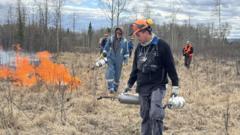
FIGHTING WILDFIRES AT HOME
Illustration concept: A realistic, high-detail photograph of rural Canadian residents holding fire hoses and wearing protective gear on a forest boundary, with light smoke lingering in the distance under a dramatic evening sky.
AI summary
In response to increasingly frequent and widespread blazes across Canada, several rural residents are taking matters into their own hands by learning fire suppression techniques. This grassroots movement aims to equip homeowners with essential skills to protect their properties during wildfire outbreaks.
Why this matters
The surge in intense wildfire seasons across North America has stretched official emergency resources to their limits. Equipping rural populations with basic firefighting knowledge offers a vital secondary defense for remote properties that emergency services may struggle to reach in time. Consequently, community-led disaster management is gaining momentum as extreme climate events become more regular.
Key takeaways
- Canadian rural residents are training to combat wildfires to protect their personal properties.
- The initiative arises from an increase in the frequency and intensity of wildfire events across the country.
- Training focuses on immediate fire suppression techniques, mitigation, and home protection tactics.
- Community preparedness is serving as a complementary layer of defense alongside government firefighting services.
Amid an escalating surge in frequent and widespread wildfire events across Canada, a growing number of rural citizens are taking direct action to defend their properties. According to a report by BBC Science, residents in remote communities are undergoing training to fight approaching blazes themselves rather than relying solely on traditional emergency response channels.
The shift comes as severe wildfire seasons increasingly strain public emergency infrastructure and local fire departments. In response, local volunteers and homeowners in high-risk zones are equipping themselves with practical skills in fire mitigation, water pump operation, and structural protection techniques.
Proponents of community-led fire defense emphasize that timely intervention during the initial stages of a wildfire can prevent localized spot fires from consuming entire structures. By learning basic fire behavior and safety protocols, rural residents hope to create safer buffer zones around their properties.
While government agencies continue to oversee large-scale containment operations, these localized self-defense efforts reflect a changing paradigm in climate adaptation. As severe weather patterns persist, community empowerment and hands-on preparation are becoming critical elements of rural survival in wildfire-prone areas.
Frequently asked questions
- Why are Canadian residents learning to fight wildfires themselves?
- With wildfires becoming more frequent and widespread, residents in vulnerable rural areas are training to defend their homes directly, especially when official emergency teams are stretched thin.
- What kind of training are these rural residents undergoing?
- Residents are gaining practical skills in fire mitigation, basic fire suppression, pump operation, and strategies to prevent embers from igniting structures.
- Does community firefighting replace official emergency services in Canada?
- No, community efforts serve as a localized secondary defense aimed at immediate property protection, while official government services handle larger regional suppression operations.
Source & transparency
- By:
- The Reviser Desk
- Source:
- BBC Science
- Original publication:
- Aug 9, 2026, 11:02 PM
- The Reviser publication:
- Aug 9, 2026, 11:02 PM
- Updated:
- Aug 10, 2026, 1:31 PM
This report was independently written by The Reviser editorial desk from verified source material. It is not original on-the-ground reporting by The Reviser.
Related stories

OCEAN HEAT RECORD JULY
Global Oceans Reach Record High Temperatures in July
AI summaryGlobal marine temperatures climbed to their highest July level on record, according to data highlighted by BBC Science. The spike in ocean heat is partially attributed to emerging El Niño climate patterns, occurring alongside intense wildfires across western Europe.

HOW DOGS READ SMILES
How Canine Brains Process Human Smiles and Scowls
AI summaryA recent scientific study reported by BBC Science has uncovered the neural activity inside a dog's brain when observing human facial expressions. Researchers observed distinct brain responses when dogs were exposed to human smiles compared to scowls.
HOSEPIPE BANS IN EFFECT
Drought Triggers Hosepipe Bans for Over 20 Million Homes
AI summaryMillions of residents are facing mandatory water use restrictions following an official drought declaration. Increased consumer demand combined with prolonged low rainfall has prompted hosepipe bans affecting over 20 million households.

DOUBLE SKY SHOW NEXT WEEK
Solar Eclipse and Perseid Meteor Shower Due Next Week
AI summaryAstronomy enthusiasts are preparing for a rare double celestial spectacle scheduled for next week. A significant partial solar eclipse will obscure much of the sun before the annual Perseid meteor shower reaches its maximum activity.