Rare European Solar Eclipse Obscures 95% of Sun in Cornwall
Skywatchers Across Europe Gather to Witness Rare Solar Eclipse
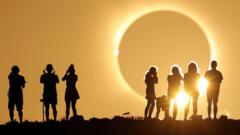
RARE SOLAR ECLIPSE SWEEPS EUROPE
Illustration concept: A dramatic photograph of a total solar eclipse showing the glowing solar corona against a dark sky above a silhouette of European terrain.
AI summary
A major solar eclipse captivated onlookers across parts of Europe and the United Kingdom, according to reports from BBC Science. Obscuration reached over 95 percent in Cornwall, while viewers in regions of Spain experienced a total solar eclipse.
Why this matters
Total and deep partial solar eclipses are rare phenomena over specific European locations, often separated by decades. Events like these offer scientists crucial opportunities to study atmospheric shifts while encouraging public engagement with astronomy.
Key takeaways
- Parts of Spain experienced a total solar eclipse during the celestial event.
- Cornwall in the United Kingdom witnessed over 95 percent solar coverage.
- BBC Science reported widespread public interest across Western Europe.
Skywatchers across Europe gathered to observe a celestial spectacle as a major solar eclipse swept across the continent, offering dramatic views from the British Isles down to Southwestern Europe.
According to BBC Science, observers in Cornwall saw the Moon cover more than 95 percent of the solar disk, plunging the region into near-total darkness during the peak of the event.
Farther south, viewers in selected regions of Spain were treated to an even more dramatic view as the Moon completely blocked the Sun, delivering a total solar eclipse.
Astronomical events of this magnitude draw extensive interest from both professional astronomers and public onlookers due to the relative scarcity of major solar eclipses visible across densely populated European corridors.
Frequently asked questions
- Where was the total solar eclipse visible?
- According to BBC Science, parts of Spain were positioned directly in the path of totality, experiencing a complete solar eclipse.
- How much of the Sun was covered in Cornwall?
- In Cornwall, the Moon obscured more than 95 percent of the Sun during the peak of the eclipse.
- Who reported this solar eclipse event?
- Details of the celestial event were published by BBC Science.
Source & transparency
- By:
- The Reviser Desk
- Source:
- BBC Science
- Original publication:
- Aug 12, 2026, 9:53 PM
- The Reviser publication:
- Aug 12, 2026, 9:53 PM
- Updated:
- Aug 12, 2026, 10:02 PM
This report was independently written by The Reviser editorial desk from verified source material. It is not original on-the-ground reporting by The Reviser.
Related stories
UK SOLAR ECLIPSE WEDNESDAY
UK Prepares for Rare Solar Eclipse Under Clear Wednesday Skies
AI summarySkywatchers across the United Kingdom are anticipating a major astronomical display as a solar eclipse approaches this Wednesday. Reports indicate optimal atmospheric conditions across widespread areas, offering observers a clear view of one of the most notable celestial events in recent decades.
96% ECLIPSE OVER ENGLAND
Partial Solar Eclipse to Obscure Up to 96% of Sun in August
AI summaryParts of England are expected to experience a major celestial event on August 12 as a partial solar eclipse sweeps across the region. At its peak, the moon could block out up to 96 percent of the sun in certain locations, according to reports from BBC Science.

SOLAR ECLIPSE TIPS
Young Astronomy Enthusiast Shares Solar Eclipse Tips
AI summaryEleven-year-old space enthusiast Efan Dafydd has shared practical guidance for spectators planning to watch a solar eclipse. His deep interest in astronomy expanded significantly after meeting his role model, astronaut Tim Peake, according to BBC Science.
DOUBLE SKY EVENT NEXT WEEK
Perseid Meteors and Solar Eclipse Set for Next Week
AI summaryAstronomy enthusiasts are preparing for two prominent astronomical phenomena occurring next week. According to BBC Science, a deep partial solar eclipse will be followed immediately by the peak of the annual Perseid meteor shower.