Pakistan Saudi Arabia Turkiye Defense Pact Reshapes Security
Trilateral Defense Alliance Signals Shift in Regional Security Architecture

TRILATERAL DEFENSE PACT SIGNED
Illustration concept: A high-tech digital world map highlighting glowing connection lines between Islamabad, Riyadh, and Ankara, symbolizing a strategic defense pact across South Asia, Middle East, and Europe, cinematic news style.
CSS / PCS revision
Key points, takeaways and exam-style Q&A formatted as a printable one-file study pack.
AI summary
A recent defense agreement involving Pakistan, Saudi Arabia, and Turkiye has expanded previous bilateral ties into a trilateral security framework across South Asia, the Middle East, and Europe. According to an analysis by Dawn Opinion, this partnership creates a major strategic block amid rising global security challenges.
Why this matters
This tripartite security alliance bridges South Asia, the Middle East, and Europe, combining military, economic, and technological strengths. Understanding this pact is crucial as it demonstrates how middle-tier powers are constructing self-reliant security alliances to navigate ongoing global conflict and changing power alignments.
Key takeaways
- The trilateral pact expands the pre-existing Pakistan-Saudi bilateral defense agreement by integrating Turkiye into a broad cross-regional alliance.
- Combining Saudi economic strength, Pakistani military capability, and Turkish defense technology creates a multifaceted strategic arrangement.
- For Pakistan, the alignment enhances defense cooperation and diplomatic flexibility while requiring careful balancing in global affairs.
- The agreement highlights a structural shift toward autonomous defense arrangements among major non-Western regional actors amidst global instability.
The emergence of a new tripartite alliance involving Pakistan, Saudi Arabia, and Turkiye marks a pivotal shift in trans-regional security. Building on a prior bilateral pact signed between Islamabad and Riyadh last year, Ankara's recent entry elevates the partnership into a trilateral defence framework connecting South Asia, the Middle East, and Europe amidst escalating global conflicts, as highlighted in a Dawn Opinion analysis.
Proponents view this trilateral convergence as a pragmatic response to shifting global power dynamics and expanding geopolitical instability. By combining Saudi Arabia's financial stature, Pakistan's established defense capabilities, and Turkiye's technological and military capacity, the alliance establishes a multi-dimensional strategic footprint across three interconnected regions.
For Pakistan, expanding its traditional security tie-up with Riyadh to include Ankara offers significant diplomatic leverage and defense cooperation opportunities. However, managing complex diplomatic balances requires careful navigation to preserve broader international relationships while solidifying regional strategic commitments.
Beyond immediate national interests, the pact reflects a structural transformation in how regional security is organized. The cross-continental arrangement underscores a growing preference among key nations for collective defence frameworks that offer mutual protection and strategic autonomy during times of international unpredictability.
Ultimately, the triangular defence agreement represents a realistic recalibration of regional security architecture. For students of international relations and competitive examination candidates, the development serves as a classic study in coalition building, demonstrating how middle powers cooperate across geographical boundaries to safeguard shared strategic interests.
Frequently asked questions
- What is the new trilateral defense pact involving Pakistan?
- It is a strategic security agreement signed between Pakistan, Saudi Arabia, and Turkiye, expanding on last year's bilateral agreement between Islamabad and Riyadh.
- Which regions are covered by this strategic alliance?
- The alliance spans three major strategic zones: South Asia (Pakistan), the Middle East (Saudi Arabia), and Europe (Turkiye).
- How does Turkiye's entry alter the earlier bilateral agreement?
- Turkiye's inclusion broadens the initial Pakistan-Saudi defence architecture, incorporating Turkish technological and military capabilities into a broader triangular framework.
Source & transparency
- By:
- The Reviser Desk
- Source:
- Dawn Opinion
- Original publication:
- Aug 12, 2026, 2:47 AM
- The Reviser publication:
- Aug 12, 2026, 2:47 AM
- Updated:
- Aug 12, 2026, 3:01 AM
This report was independently written by The Reviser editorial desk from verified source material. It is not original on-the-ground reporting by The Reviser.
Related stories
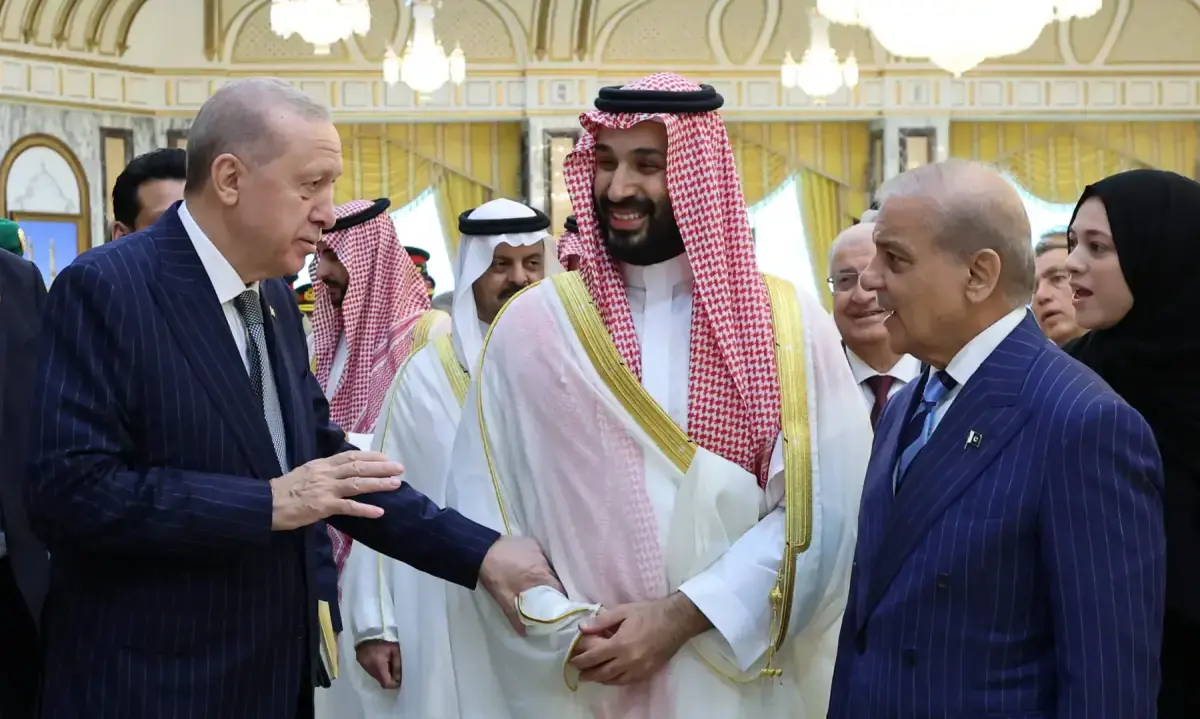
PAKISTAN IRAN DEFENSE PACT TALKS
Pakistan Balances Regional Ties via Makkah Security Pact
AI summaryFollowing the signing of the Makkah Joint Defence Agreement alongside Saudi Arabia and Turkiye, Islamabad actively engaged Tehran to prevent diplomatic friction. Iranian officials welcomed the assurances, noting that regional security architecture must increasingly rely on intra-regional cooperation rather than Western security guarantees.

REFORMS OR CONSTITUTIONAL VIOLATIONS?
Constitutional Reforms and Provincial Restructuring in Pakistan
AI summaryRecent proposals by Pakistan's interior minister have reignited national debate regarding large-scale constitutional reforms and the creation of new provinces. According to analysis published by Business Recorder Opinion, meaningful governance reform requires strict adherence to constitutional boundaries rather than hasty structural restructuring.

MICHIGAN SENATE DIPLOMACY DEBATE
Michigan Senate Race Highlights US Foreign Policy Dilemma
AI summaryA commentary published by NYT Opinion examines the political messaging required for Democratic nominees in swing states like Michigan regarding Middle East policy. The piece explores how candidates attempt to navigate competing voter demands while maintaining broad electoral coalitions.
POWER TRUST RISK RETURN
Resurgent Power Trusts Threaten Energy Market Stability
AI summaryA resurgence of debt-heavy mega-mergers in the power sector mirrors the utility monopolies of a century ago, according to commentary from Project Syndicate. This analytical piece examines the risks of utility consolidation, corporate leverage, and the strategic policy lessons for Pakistan’s energy governance.