South Korea Stock Market Volatility Causes Heavy Retail Losses
South Korean Stock Market Downturn Leaves Retail Investors Facing Massive Losses

KOREAN STOCKS SWING SHARPLY DOWNWARD
Illustration concept: A realistic financial news photo showing digital stock chart screens with falling red trendlines inside a modern office in Seoul, with a blurred silhouette of a trader in the background.
AI summary
Recent heightened price volatility and a sharp market correction in South Korea have inflicted heavy losses on retail investors. Some individual traders report losing substantial sums within weeks as market conditions abruptly shifted.
Why this matters
Retail participation in South Korea's equities market has expanded significantly, leaving household investors deeply exposed to sudden market corrections. Understanding the impact of these market swings provides critical context on consumer financial stability and investment risks across Asian financial hubs.
Key takeaways
- South Korea's stock market experienced a sharp correction that triggered significant losses for individual traders.
- Specific individual accounts suffered rapid drawdowns, including reported monthly losses reaching $14,000.
- The severe price swings underscore the risks confronting retail investors during sudden equities market downturns.
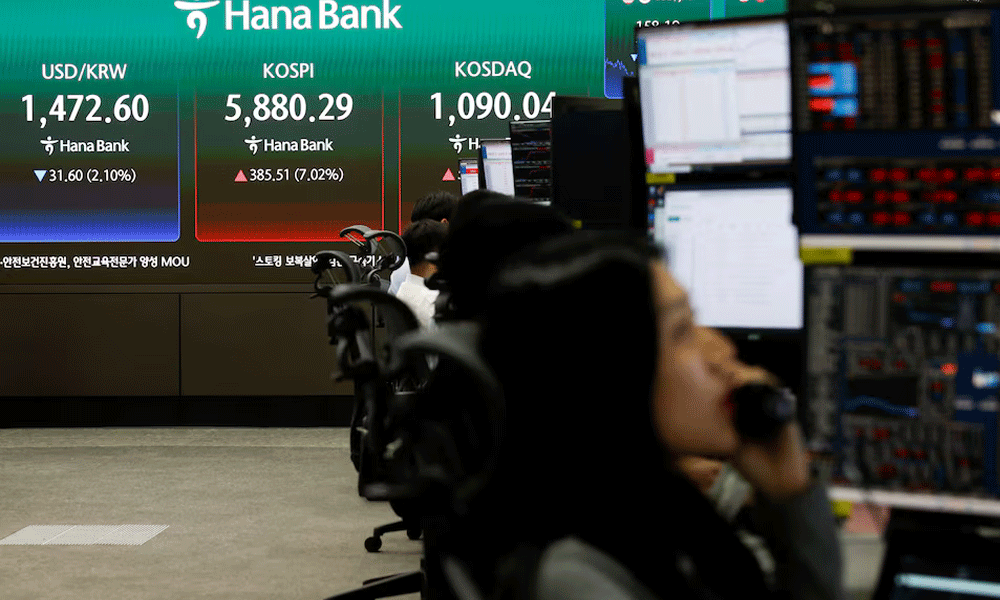
A sharp market correction in South Korea has wiped out substantial capital for retail investors, leaving individual traders grappling with major financial setbacks following rapid swings in share prices.
According to a report by BBC Technology, individual market participants are reeling from severe losses incurred over brief periods. In one instance, an investor reported losing $14,000 within a single month as sudden equities downturns eroded portfolio values.
South Korea's stock market has experienced intense volatility, with rapid shifts in price momentum catching many retail investors off guard. The sharp pullback follows a period of heightened market activity that attracted significant volumes of individual trading.
The market downturn highlights the heightened risks faced by non-institutional investors who engaged heavily during recent market rallies. As equities reverse gains, retail portfolios remain vulnerable to severe drawdowns during broader financial market adjustments.
Frequently asked questions
- What led to financial losses for retail traders in South Korea?
- A sharp correction and heightened volatility in South Korea's stock market led to rapid price drops, impacting individual investor portfolios.
- How large were the reported individual investor losses?
- Reports indicate that some traders experienced severe declines, with single-month losses reported as high as $14,000.
- Who published the report on South Korea's stock market volatility?
- The details regarding the market correction and investor impact were reported by BBC Technology.
Source & transparency
- By:
- The Reviser Desk
- Source:
- BBC Technology
- Original publication:
- Aug 13, 2026, 10:00 PM
- The Reviser publication:
- Aug 13, 2026, 10:00 PM
- Updated:
- Aug 13, 2026, 10:18 PM
This report was independently written by The Reviser editorial desk from verified source material. It is not original on-the-ground reporting by The Reviser.
Related stories
KOSPI BOUNCES BACK IN SEOUL
South Korea KOSPI Bounces Back as Chip Stocks Rally
AI summarySouth Korea's KOSPI index rebounded on Monday, gaining 0.80 percent to reach 6,308.74 after seven consecutive weeks of declines. The advance was spearheaded by semiconductor manufacturers following a record-setting session on Wall Street.
WHOLESALE PRICES STAGNATE IN JULY
July US Wholesale Prices Unchanged Below 0.2 Percent Forecast
AI summaryWholesale inflation in the United States recorded zero growth during July, falling short of market projections. Analysts surveyed by Dow Jones had anticipated a 0.2% increase in the Producer Price Index for the month.

SRI LANKAN SHARES GAIN
Sri Lankan Shares Extend Gains for Fourth Straight Session
AI summarySri Lankan equities advanced for a fourth consecutive trading day on Monday, supported by gains in real estate and communication services counters. While foreign funds continued offloading equities, robust buying by domestic investors pushed total turnover sharply higher.
JULY CPI UP 0.1%
July US Inflation Rate Hits 3.4 Percent as Prices Rise 0.1%
AI summaryAmerican inflation tracked expectations in July as the consumer price index registered a modest 0.1 percent monthly gain. The increment settled the annual inflation pace at 3.4 percent, according to CNBC Markets.