Court Halts $400M White House Ballroom Plan
Appeals Panel Rules President Needs Approval for White House Redesign
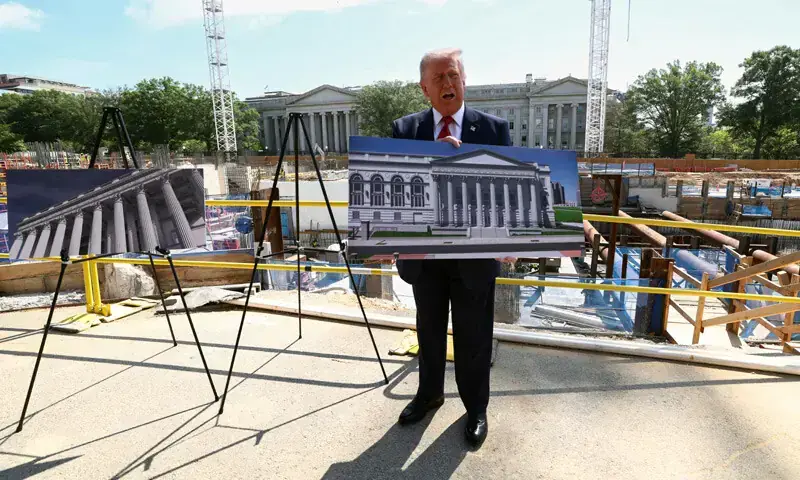
COURT STOPS BALLROOM PROJECT
Illustration concept: A professional wide shot of the White House under overcast skies, showing construction barriers and heavy equipment halted near the East Wing, realistic news photographic style.
AI summary
A federal appeals court has halted construction on a planned $400 million White House ballroom after ruling that executive power does not extend to major architectural overhauls. The decision upholds a lawsuit filed by historic preservationists, affirming that structural changes to the executive mansion require congressional authorization.
Key takeaways
- A federal appeals court issued a 2-1 decision blocking construction of a $400 million White House ballroom.
- The ruling upholds an injunction won by the National Trust for Historic Preservation following the demolition of the East Wing.
- Judges stated that presidents are temporary tenants who cannot fundamentally alter the White House without congressional approval.
- The 90,000-square-foot development was started without seeking authorization from Congress.
A federal appellate court in Washington has ordered an immediate halt to the White House's controversial $400 million expansion project, ruling that the executive branch overstepped its legal authority when it demolished the historic East Wing to construct a massive ballroom without legislative permission.
In a 2-1 decision issued on Friday, the U.S. Court of Appeals for the District of Columbia Circuit affirmed a lower court injunction, emphasizing that sitting commanders-in-chief lack the power to unilaterally overhaul the nation's most famous residence. The judges noted that occupants of the Oval Office serve as transient caretakers rather than owners, meaning major architectural transformations require explicit backing from lawmakers.
The legal battle stems from a lawsuit launched last year by the National Trust for Historic Preservation. Preservationists took legal action after workers leveled the original East Wing structure to clear ground for a new 90,000-square-foot facility, pointing out that no prior approval had been requested or granted by Capitol Hill before heavy machinery arrived on the grounds.
In their ruling, the majority panel made clear that decisions regarding significant structural revisions fall squarely under the purview of Congress rather than unilateral presidential discretion. The court rejected arguments that the administration possessed broad latitude to reconfigure the executive mansion, ruling that lawmakers never granted the executive branch unchecked power to drastically alter the iconic complex to suit an individual president's preferences.
Frequently asked questions
- Why did the appeals court halt the White House ballroom construction?
- The court ruled that presidents do not have the power to unilaterally redesign or demolish parts of the White House without authorization from Congress.
- Who initiated the legal challenge against the ballroom project?
- The National Trust for Historic Preservation filed the lawsuit after the East Wing was demolished and construction began on the 90,000-square-foot ballroom without congressional consent.
- What was the specific ruling from the court panel?
- In a 2-1 decision, the appellate panel upheld a preliminary injunction, emphasizing that each president is a temporary tenant rather than an owner and cannot execute major structural changes on their own.
Source & transparency
- By:
- Mikle
- Source:
- Dawn World
- The Reviser publication:
- Aug 8, 2026, 2:52 AM
- Updated:
- Aug 8, 2026, 1:00 PM
This report was independently written by The Reviser editorial desk from verified source material. It is not original on-the-ground reporting by The Reviser.
Related articles
KURDISTAN REJECTS WAR INVOLVEMENT
Kurdish Iraq Seeks Neutrality Amid Regional Clashes
AI summaryKurdistan Regional Government Prime Minister Masrour Barzani stated that Iraqi Kurdistan intends to remain neutral in escalating Middle Eastern conflicts. Speaking to Al Jazeera, Barzani affirmed that no external pressure has been placed on the region to participate in hostilities concerning Iran, despite facing more than 1,000 attacks.

ASTRA DEVELOPMENT HALTED
OpenAI Halts Some Astra AI Work Over Cyber Risk Fears
AI summaryInternal development on OpenAI's next-generation model, Astra, has been partially suspended following fears it may possess advanced cyberattack capabilities. The precautionary measures were enacted under safety guidelines after concerns arose that the system could autonomously discover and exploit severe software vulnerabilities.

HORMUZ DEAL NEARLY CLOSED
Iran-Oman Strait of Hormuz Deal Nears But Reopening Delayed
AI summaryIran and Oman are closing in on an agreement regarding maritime routes through the Strait of Hormuz, though Tehran insists the waterway will remain restricted without US compensation. Meanwhile, fresh security incidents in the region highlight the lingering volatility threatening global energy supplies.

BLANCHE CONFIRMED AS US AG
Todd Blanche Confirmed as US Attorney General in Tight Vote
AI summaryThe United States Senate has narrowly confirmed Todd Blanche, Donald Trump's former defense lawyer, as the nation's top law enforcement official. The confirmation succeeded despite resistance from a small number of Republican senators.