CME Hedge Funds Turn Net Long on Bitcoin as Basis Trade Fades
Institutional Traders Pivot to Bullish Bitcoin Bets on CME
HEDGE FUNDS GO NET LONG
Illustration concept: A modern financial trading floor visual showing digital Bitcoin symbols, futuristic upward stock charts, and financial data overlaying Chicago Mercantile Exchange graphics.
AI summary
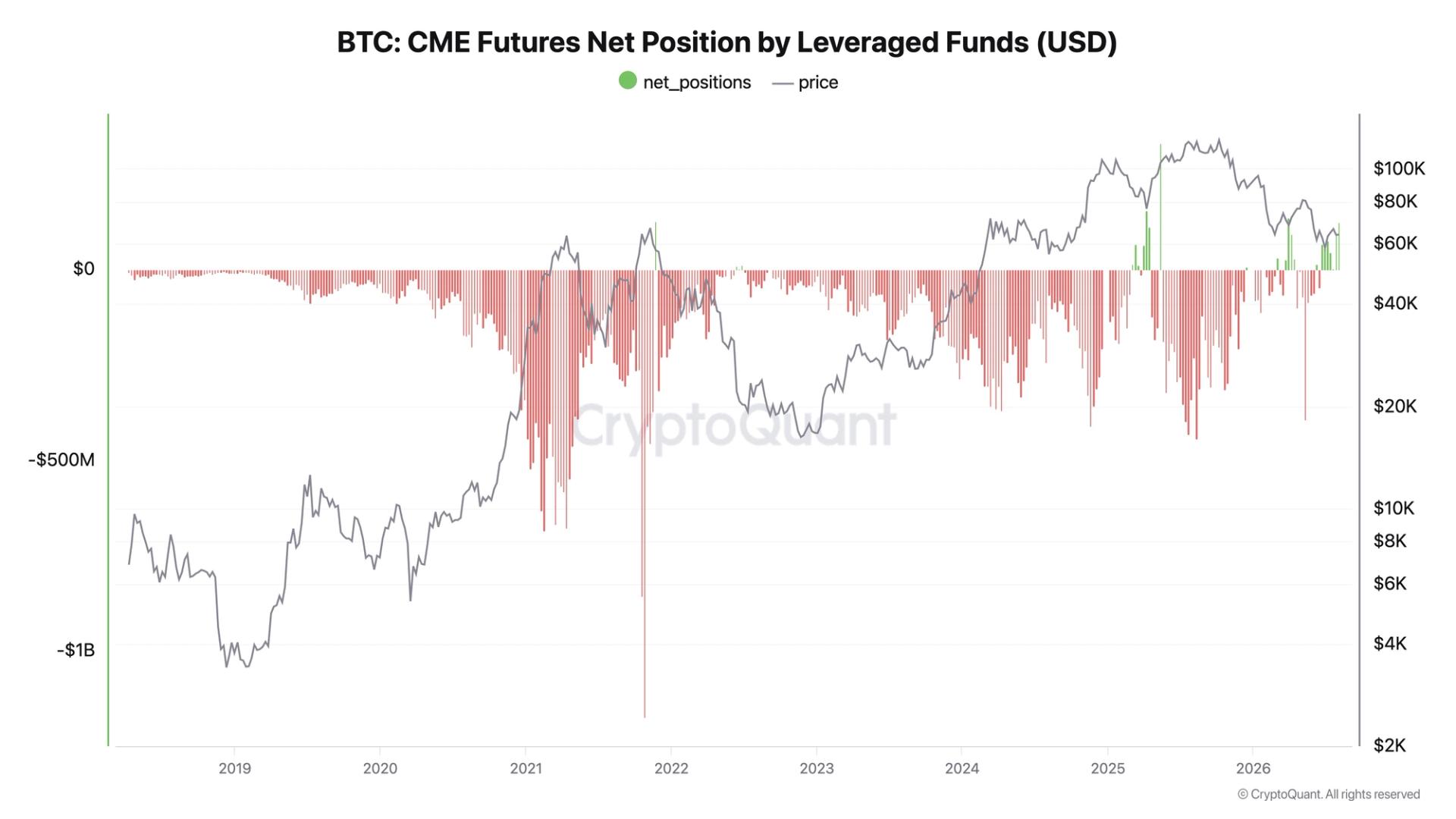
Leveraged funds on the Chicago Mercantile Exchange have abandoned their traditional short positions to go net long on Bitcoin. The rare shift follows a drop in CME futures yields, which diminished the profitability of the widely used basis trade.
Why this matters
For months, institutional investors dominated crypto derivatives using cash-and-carry strategies, maintaining massive short futures positions against spot holdings to harvest yield. A flip to net long indicates that hedge funds are increasingly willing to take unhedged directional exposure, signaling rising confidence in Bitcoin's upside potential.
Key takeaways
- CME leveraged funds have officially flipped to a net-long stance on Bitcoin.
- Declining CME futures yields reduced the profitability of the popular basis trade.
- Hedge funds are shifting away from delta-neutral arbitrage toward directional bullish bets.
Leveraged funds trading on the Chicago Mercantile Exchange (CME) have shifted their market positioning, turning net long on Bitcoin futures in a rare market realignment. According to reports from CoinDesk, institutional market participants are actively dismantling structural short positions that previously defined institutional strategy in the derivatives market.
The move marks a departure from the cash-and-carry basis trade, which had long been a staple strategy for crypto hedge funds. In a standard basis trade, funds buy spot Bitcoin or spot exchange-traded funds while simultaneously selling futures contracts at a premium, allowing them to capture a low-risk yield without taking directional market risk.
However, a compression in futures yields has significantly diminished the attractiveness of this delta-neutral strategy. As the spread between spot prices and derivative contracts narrowed, the returns generated from maintaining short futures positions no longer compensated institutional traders for the capital involved.
Faced with shrinking yields, institutional funds have adjusted their portfolios by unwinding short positions and establishing outright long exposure. The pivot reflects a transition from passive yield-seeking behavior toward directional positioning on Bitcoin's future price trajectory.
Frequently asked questions
- What does turning net long mean for CME leveraged funds?
- It indicates that institutional funds currently hold more active buy (long) positions than sell (short) contracts in Bitcoin futures on the exchange.
- Why did hedge funds abandon the Bitcoin basis trade?
- A decline in futures yields compressed the premium between spot Bitcoin and futures contracts, rendering the yield-harvesting strategy unprofitable.
- How did hedge funds previously use Bitcoin futures?
- Funds typically bought spot Bitcoin or spot ETFs and shorted futures contracts to capture annualized yield spreads without exposure to asset price swings.
Source & transparency
- By:
- The Reviser Desk
- Source:
- CoinDesk
- Original publication:
- Aug 10, 2026, 9:09 AM
- The Reviser publication:
- Aug 10, 2026, 9:09 AM
- Updated:
- Aug 10, 2026, 9:33 AM
This report was independently written by The Reviser editorial desk from verified source material. It is not original on-the-ground reporting by The Reviser.
Related stories

BITCOIN FORK STALLS AFTER LAUNCH
BIP-110 Bitcoin Fork Stalls After Mining Just Two Blocks
AI summaryThe controversial BIP-110 Bitcoin fork came to a near-total halt shortly after launch, managing to mine only two blocks before stalling. The network inherited Bitcoin's elevated mining difficulty while commanding only a negligible fraction of global hashpower.

1% BITCOIN CAPITAL SHIFT
Bitwise CIO Forecasts Institutional Bitcoin Surge
AI summaryBitwise Chief Investment Officer Matt Hougan projects significant growth potential for Bitcoin driven by major institutional capital. According to reports from CoinDesk, directing just 1% of the $200 trillion controlled by global funds could unlock massive market expansion.
PATCH LIGHTNING NODES NOW
BTCPay Server Exploited: LND Users Warned to Patch
AI summaryBTCPay Server has instructed node administrators relying on the Lightning Network Daemon to update their software or disconnect immediately. The emergency alert follows an exploit that allowed unauthorized actors to extract administrative credentials and drain connected Bitcoin wallets.

XRP DROPS AS ALTCOINS RALLY
XRP Price Falls 5% as Bitcoin and Major Altcoins Rally
AI summaryXRP registered a 5% decline over the past week, standing out as a notable laggard during a broader cryptocurrency market rebound. Meanwhile, major digital assets including Bitcoin, Ethereum, and Solana posted gains amid persistent investment fund flows.