Bitcoin Drops Below $63,000 as Rising Oil Prices Push Bond Yields
Bitcoin Falls Under $63,000 Amid Escalating Crude Oil Prices and Rising Yields

BITCOIN SLIPS BELOW $63K
Illustration concept: A modern conceptual financial illustration showing a falling digital Bitcoin symbol alongside rising oil barrels and an ascending bond yield chart, dark blue and neon red lighting.
AI summary
Bitcoin fell below the $63,000 mark as rising crude oil prices and climbing treasury yields created macroeconomic headwinds. According to CoinDesk, WTI crude surpassed $82 per barrel, intensifying inflation concerns across financial markets.
Why this matters
Rising energy costs directly reignite inflation worries, prompting investors to seek safety in fixed-income markets rather than high-risk investments. When treasury yields surge alongside commodity prices, speculative assets such as cryptocurrencies often face sharp liquidity outflows.
Key takeaways
- Bitcoin's market price tumbled beneath $63,000 amid broader macroeconomic selling pressure.
- West Texas Intermediate (WTI) crude oil breached $82 a barrel, raising inflation anxieties.
- Higher bond yields are dampening investor appetite for speculative risk assets including cryptocurrencies.
- Reports from CoinDesk indicate that energy market dynamics continue to drive investor sentiment.
High energy costs and ascending sovereign bond yields have intensified selling pressure across speculative financial markets, dragging the value of Bitcoin beneath the $63,000 threshold.
According to reports from CoinDesk, West Texas Intermediate (WTI) crude oil climbed beyond $82 per barrel. The rapid surge in energy benchmarks has renewed fears of sticky global inflation, prompting traders to reassess risk exposure.
As crude oil gains momentum, government bond yields have moved higher in tandem. Elevated yields tend to attract capital into fixed-income instruments while making high-volatility holdings significantly less appealing to institutional and retail investors.
The combination of climbing energy expenditures and rising yields continues to exert downward pressure on risk assets broadly, maintaining a challenging macroeconomic backdrop for the digital asset ecosystem.
Frequently asked questions
- Why did Bitcoin fall below $63,000?
- Bitcoin declined as rising WTI crude oil prices over $82 a barrel and higher treasury yields intensified global inflation concerns, reducing appetite for risk assets.
- How do higher oil prices affect cryptocurrency markets?
- Elevated oil prices exacerbate inflation fears, which often leads central banks to maintain higher interest rates, causing investors to shift capital from volatile digital assets to safer yields.
- What price benchmark did WTI crude reach?
- West Texas Intermediate (WTI) crude oil surpassed $82 per barrel according to market reports from CoinDesk.
Source & transparency
- By:
- The Reviser Desk
- Source:
- CoinDesk
- Original publication:
- Aug 14, 2026, 8:51 AM
- The Reviser publication:
- Aug 14, 2026, 8:51 AM
- Updated:
- Aug 14, 2026, 9:03 AM
This report was independently written by The Reviser editorial desk from verified source material. It is not original on-the-ground reporting by The Reviser.
Related stories

BITCOIN $1M TARGET TOO HIGH?
Bitcoin $1M Forecasts Look Too Ambitious as Treasury Yields Soar
AI summarySoaring returns on long-term U.S. Treasury bonds are casting doubt on ultra-bullish predictions of Bitcoin reaching $1 million. Reports from CoinDesk indicate that elevated government bond yields diminish the investment appeal of non-yielding assets like cryptocurrencies.
SEC DELAYS CRYPTO RULES
SEC Delays Key Cryptocurrency Rule Proposal Meeting Indefinitely
AI summaryThe U.S. Securities and Exchange Commission has abruptly postponed a scheduled meeting to introduce its initial major cryptocurrency regulatory framework. According to CoinDesk, federal regulators did not immediately establish a new calendar date for the session.
BITCOIN DIPS NEAR $63.5K
Bitcoin Edges Toward $63,500 as Traders Eye Fed Catalysts
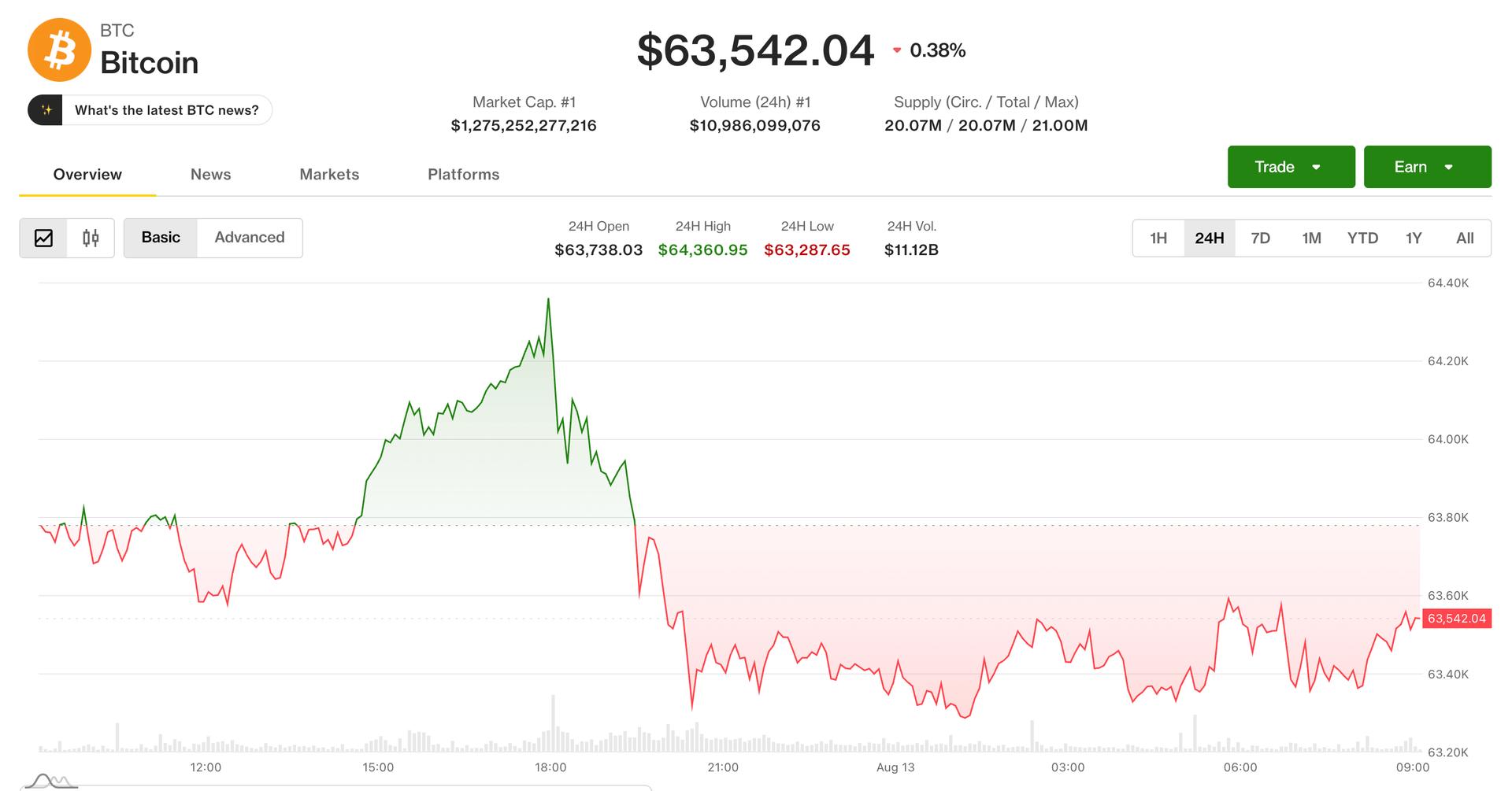
AI summaryBitcoin experienced a mild pull-back close to $63,500 as an inflation reading matching expectations failed to generate buying momentum. Crypto market participants are now turning their attention toward upcoming economic events, including Jackson Hole and employment data, for directional cues.

CRYPTO SLUMP XRP AT $1
Crypto Market Slumps as Bitcoin and XRP Face Headwinds
AI summaryMajor digital assets are nursing losses following a shift toward harsher regulatory conditions. A lack of momentum from traditional financial markets and institutional exchange-traded fund flows has left tokens like Bitcoin and XRP struggling to hold key price levels.